
 My Etsy Store
How to Sew a Shirt Collar
Category: Tutorials 04 March 25
Ad: This tutorial is a complementary post for the Sienna: Button-Down Blouse pattern, which is now available for sale on Etsy.
The Prologue
I didn’t plan to write about collars. The truth is, after spending weeks and months designing, planning, and drowning under the weight of the never-ending tasks that came with the Sienna pattern launch, I didn’t plan to write anything. Not. A single. Line.
Yet months later, I found myself curled up on the couch, lazily flipping through the pages and reluctantly looking for ideas that might someday become a new design on my desk. Instead of a new idea, my eyes landed on a passage about collars. It said:
“The work of a collar is to frame your face. And big or small, high or low, its proportions must always be very well studied. It is extraordinary how many different kinds of collars have been invented out of such a small piece of material.”
Christian Dior, “The Little Dictionary of Fashion”, 1954, C, Collars
That sentence stopped me—then sent me back a year, to when I was figuring out the shape of the Sienna’s shirt collar: pointed, loose-fitting, and slightly exaggerated to make the neck look even more elegant. I also remember debating its construction, trying to decide whether I still liked the idea of assembling the collar and collar stand together before attaching them to the blouse.
By the time I started sewing, I stumbled upon another method—the one that eventually made it into the Sienna booklet and now, into this tutorial. To me, it seemed more straightforward—I had always struggled with the inner layer of the collar stand at the edges. It also behaved better: fewer ripples, fewer surprises, and an edge that finally looked the way I always wanted it to.
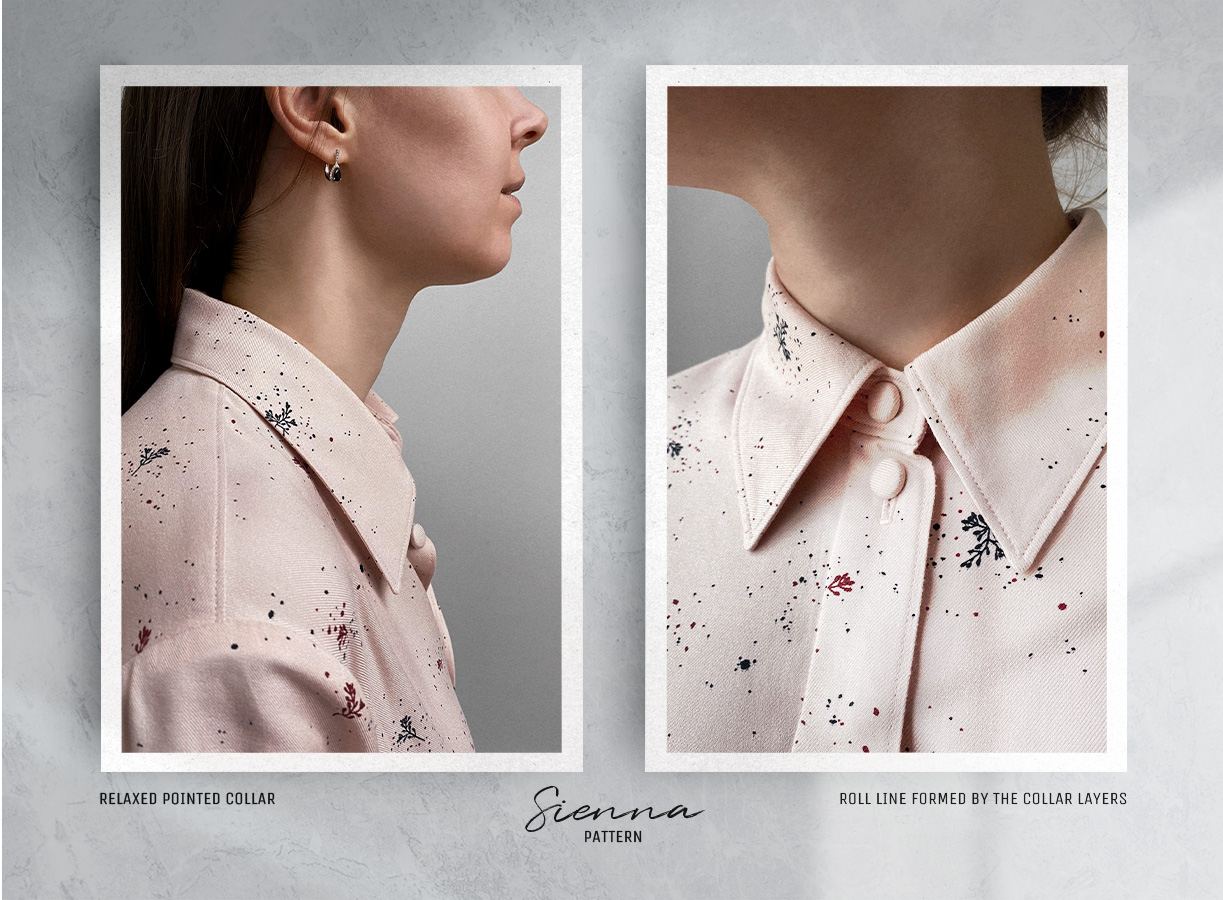
So let’s take it from the top—here are the pieces, the cutting, and every step that shapes a clean, well-behaved collar.
Fabric & Supplies
For your shirt collar, you’ll need:
- Fashion Fabric: non-stretch light- to medium-weight woven shirt and blouse fabrics. Viscose, silk crepe, twill, or satin are good options for softer blouses with drape, while crisp fabrics like cotton poplin and chambray create a classic shirt look.
- Interfacing: lightweight fusible options that match your fashion fabric. If you want the collar to have more defined outlines, choose stiffer interfacing.
- Point presser, and point turner;
- A conventional sewing machine and the rest of your regular sewing tools.
Once you’ve gathered your tools, it’s time to cut the collar pieces.
Cutting & Applying Interfacing
The instructions below use the pattern pieces included in the Sienna pattern. If you’re using a different shirt pattern, check whether it includes a separate undercollar piece—some don’t.
If your pattern doesn’t have a separate under collar, simply cut two collar pieces from the same pattern piece and use one as the “undercollar.” For a more professional finish, you can trim the undercollar piece slightly smaller—about 2 mm (a scant 1⁄8″) on the outer curve—so it rolls under and stays hidden.
With your paper pattern pieces prepared, here’s what you’ll need to cut to follow this tutorial:
- Upper Collar (1) — cut 1 on fold of fashion fabric and 1 on fold of interfacing
- Undercollar (2) — cut 1 on fold of fashion fabric and 1 on fold of interfacing
- Collar Stand (3) — cut 2 on fold of fashion fabric and 2 on fold of interfacing
Please note that this tutorial does not provide yardages for the interfacing and the fashion fabric, as they are usually cut with the rest of the shirt pieces during the cutting.
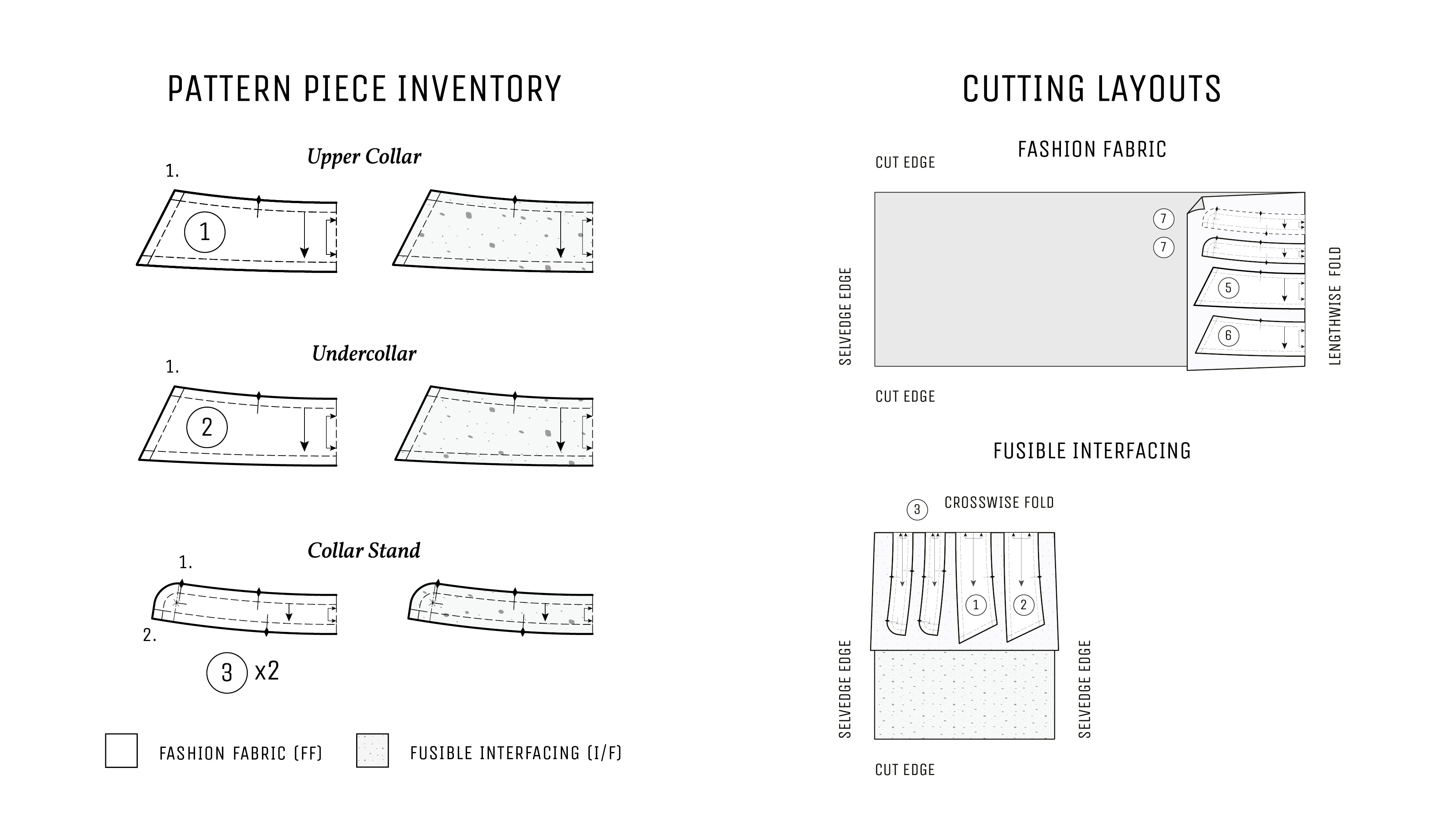
Once you’ve cut all the interfacing and fabric pieces, take a moment to apply the interfacing to the corresponding pieces: the upper collar (1), undercollar (2), and collar stand (3) ×2. This will be useful during the sewing steps that follow.
Sewing
A quick note: This tutorial follows the step-by-step instructions from the Sienna blouse pattern booklet. I’ve adjusted the piece numbers and reference marks slightly, and added a few notes to make it easier to follow on its own. If you have the full booklet, I recommend using that instead—it’s all there. But if you’re here to sew your custom shirt collar, just dive in.
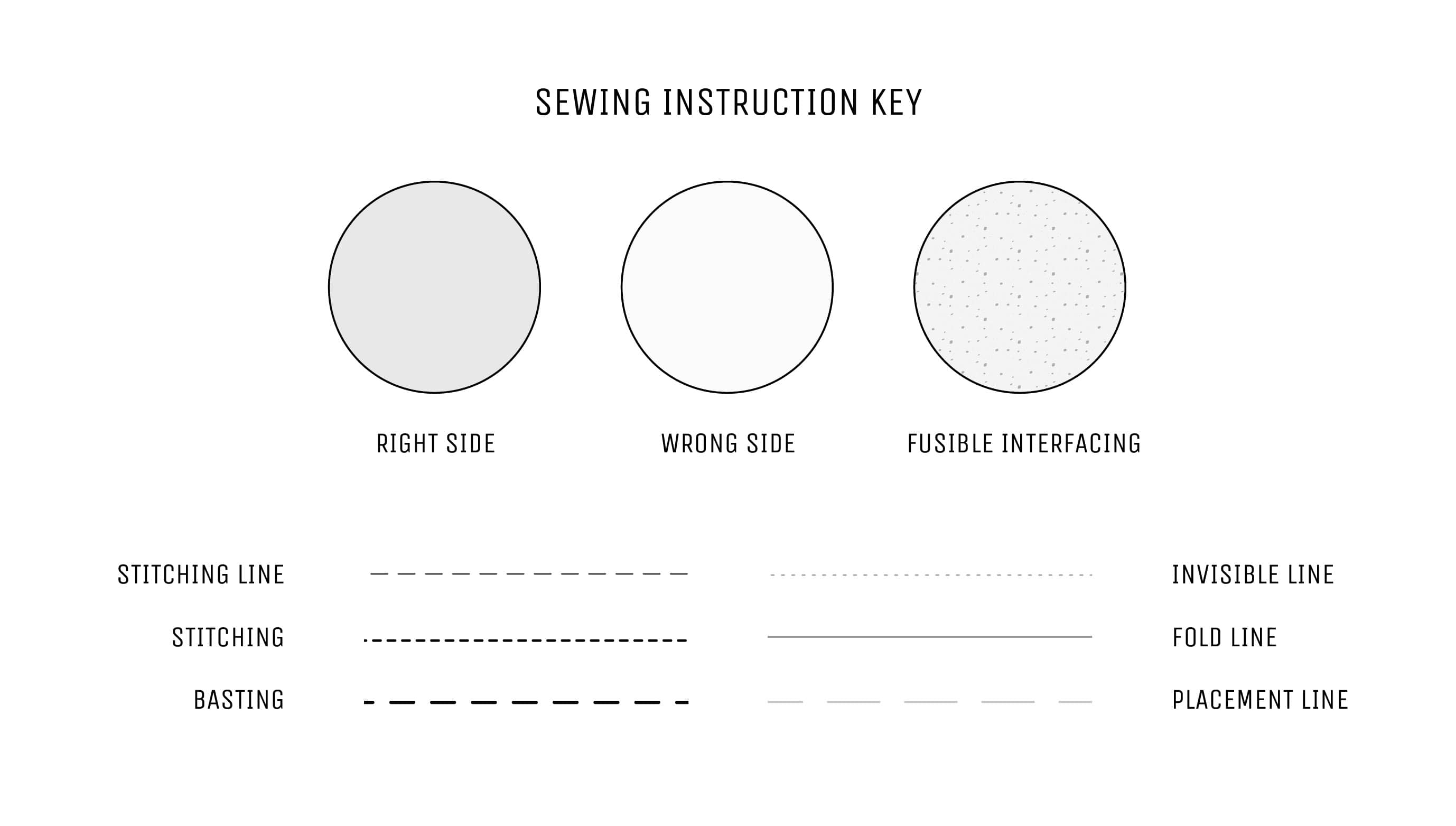
Seam Allowances: All steps in this tutorial use the Sienna blouse seam allowance of 1.2 cm (½”) for the collar, collar stand, and neckline. If your pattern uses a different value, simply apply your usual seam allowance instead.
1. Prepare the Collar
Place the fully interfaced pieces of the upper collar (1) and the undercollar (2) right sides together and pin with the outer edges even. Note that the undercollar is slightly smaller than the upper collar—this prevents the undercollar from showing on the right side once the collar is stitched to the stand.
Stitch the outer sides 1.2 cm (½″) away from the edge, taking one diagonal stitch across the corner—it’ll create a neat point when the collar is turned right side out.
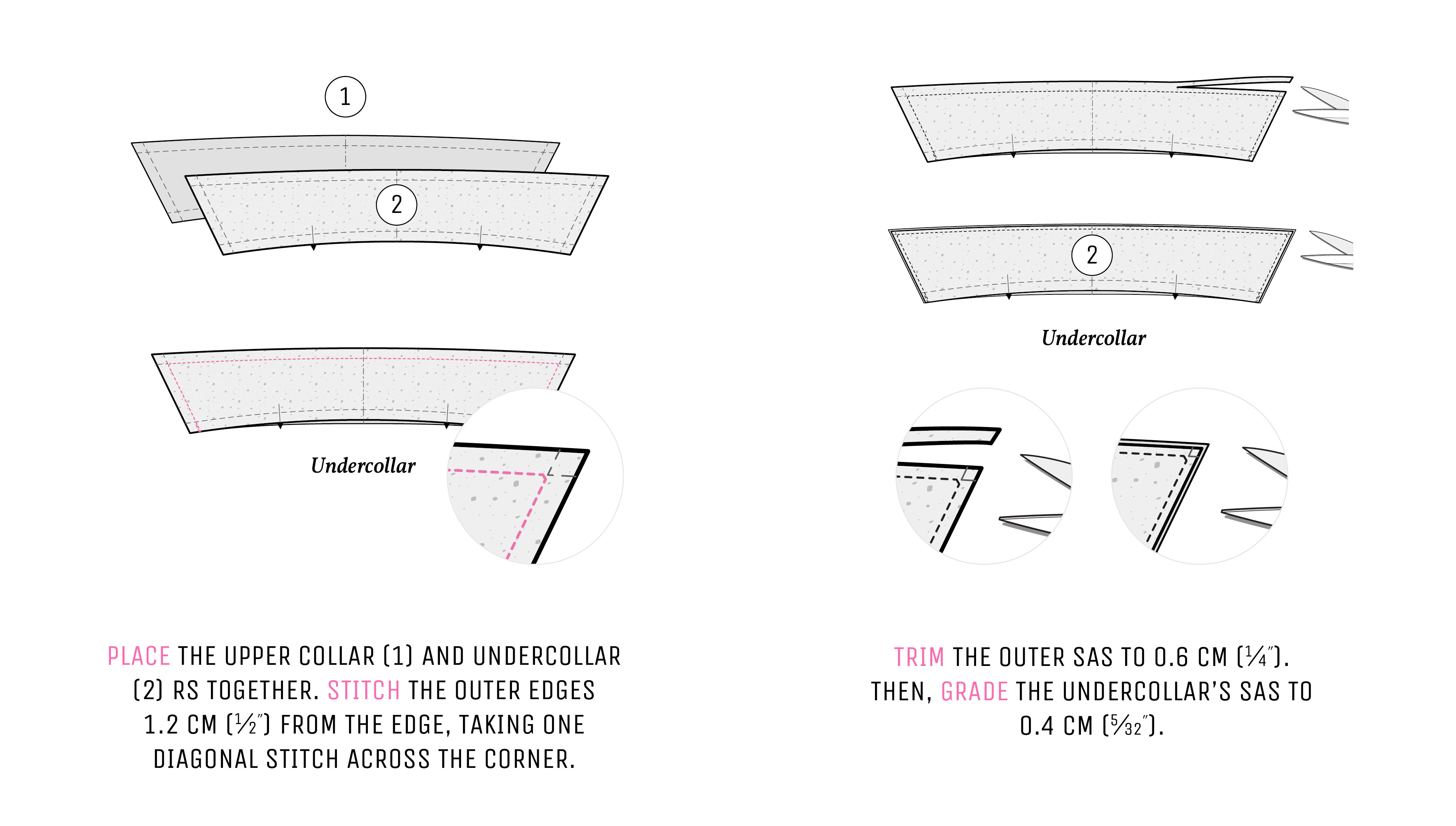
Trim the outer seam allowances to 0.6 cm (1⁄4″), then grade the undercollar’s seam allowances to 0.4 cm (5⁄32″). After that, trim the corners across the point—be careful not to cut through the stitching. Then, trim at an angle to the seam on each side of the point.
With the help of a point presser, press the seams open. Turn the collar right side out and gently push points out with the point turner. Place the undercollar facing up and press the collar’s outer edges flat, rolling the seam slightly to the undercollar, so it will not show when the collar is finished. Do not press the centre of the collar.
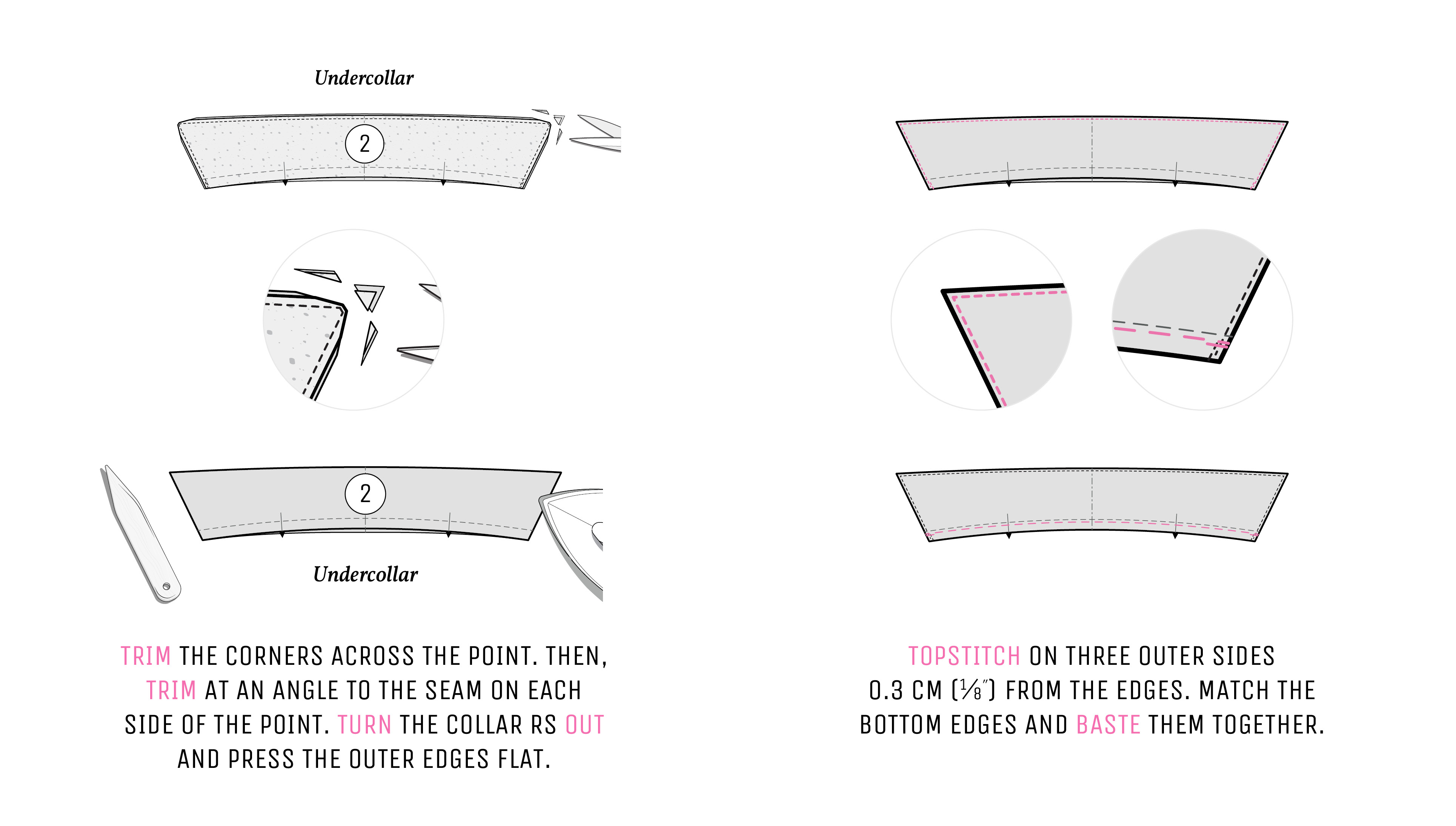
Topstitch the collar on three sides 0.3 cm (1⁄8″) from the edges. Since the upper collar is slightly bigger, it will stick from underneath the undercollar at the bottom edge. Match these edges and baste them together. Later, this extra height of the upper collar will help create a nice roll line.
2. Attach the collar & the collar stand
Pick one of the interfaced collar stands (3) and machine baste its upper edge between the collar placement notches located approx. 3 mm (1⁄8″) before the CF lines, (m. 1.)—stitch 1.2 cm (½″) away from the edge. This stand will be the inner one. Press the basted edge to the wrong side, then temporarily unfold it.
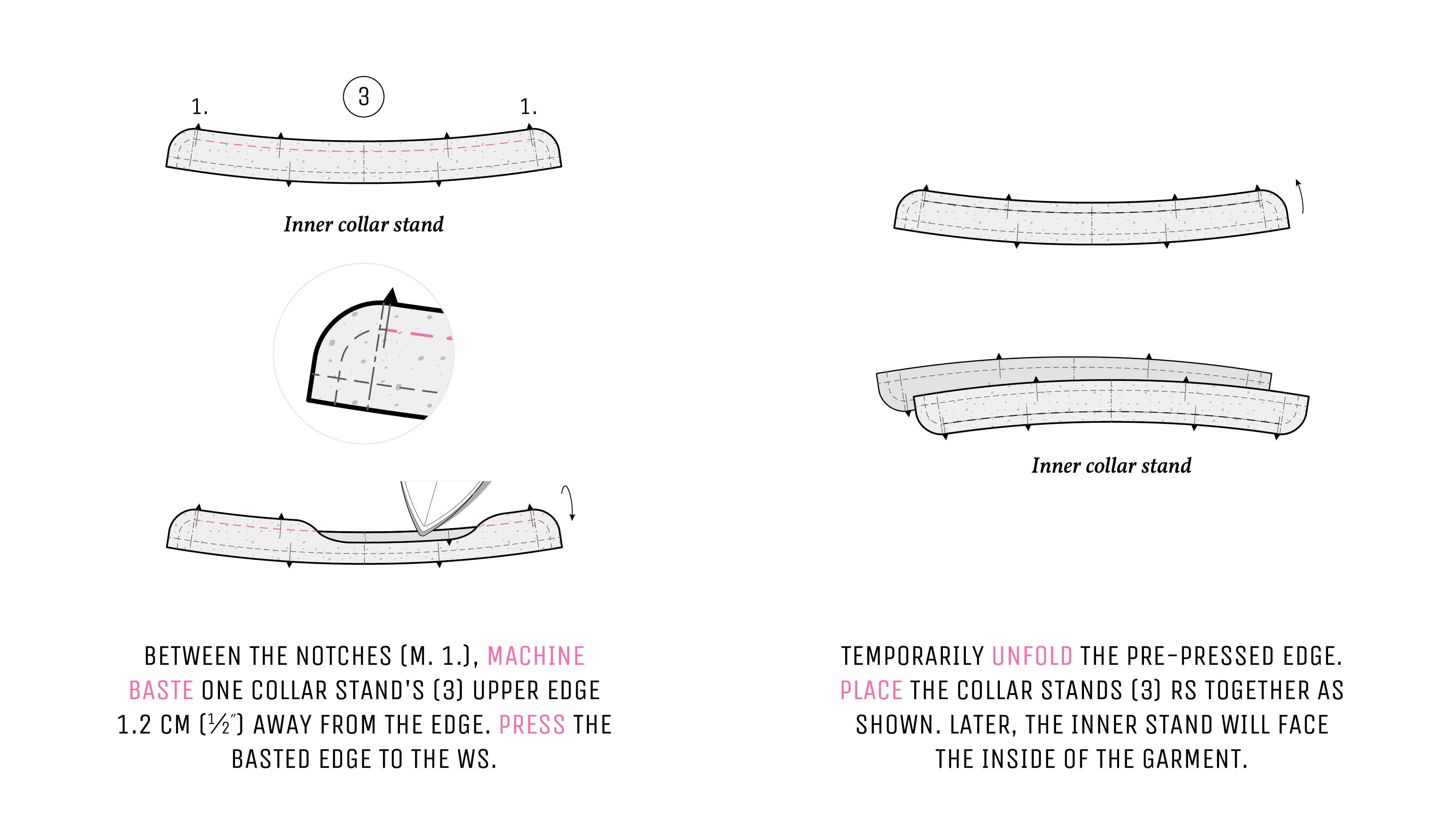
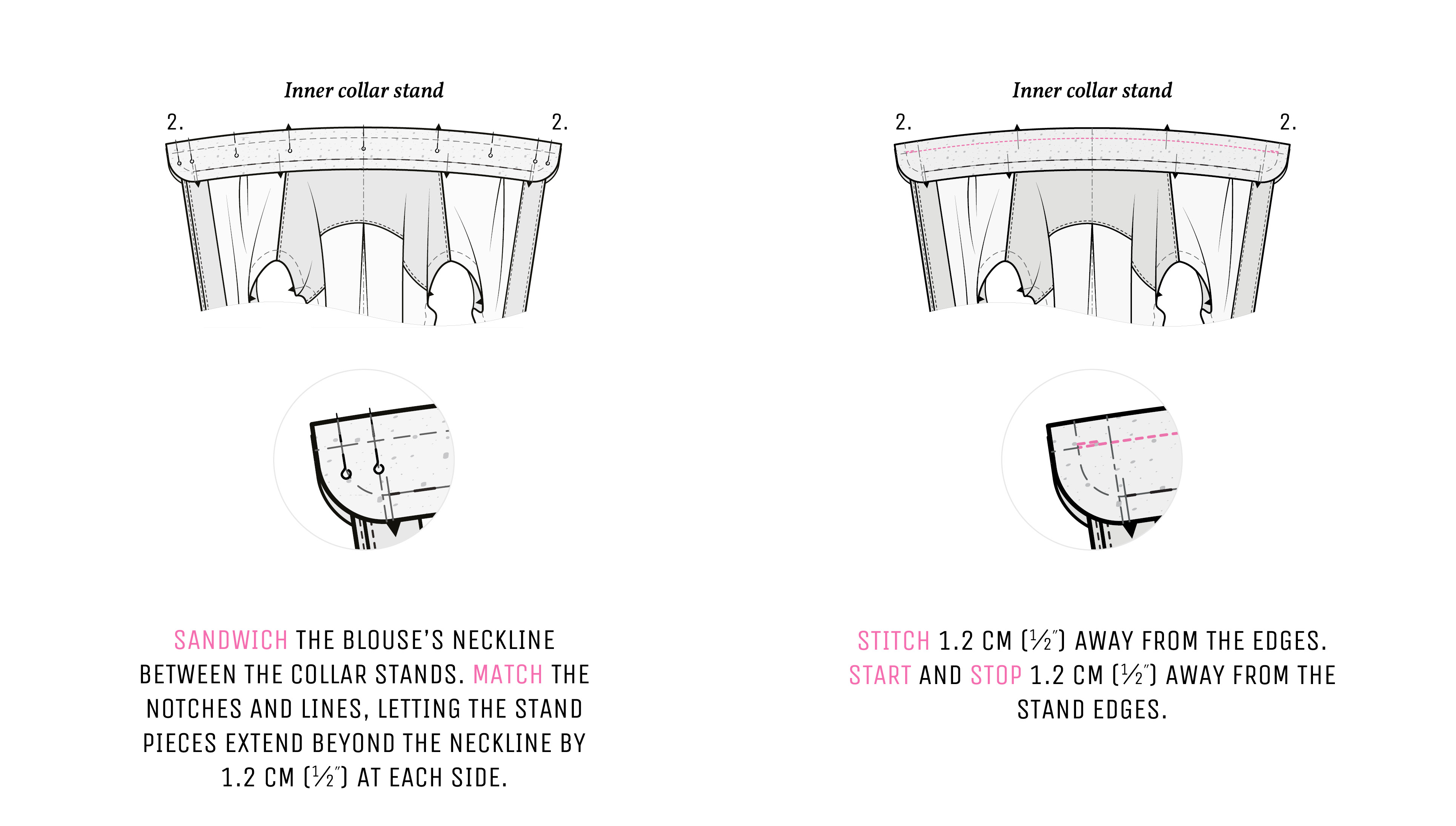
Place the collar stand (3) pieces right sides together with the blouse’s neckline sandwiched between the layers. The inner stand should face the inside of the garment. Match the notches, CB and CF lines, and pin. The stand pieces will extend beyond the neckline by 1.2 cm (½″) at each side. Stitch 1.2 cm (½″) away from the edges, watching for the layers to match. Start and stop 1.2 cm (½″) away from the stand edges.
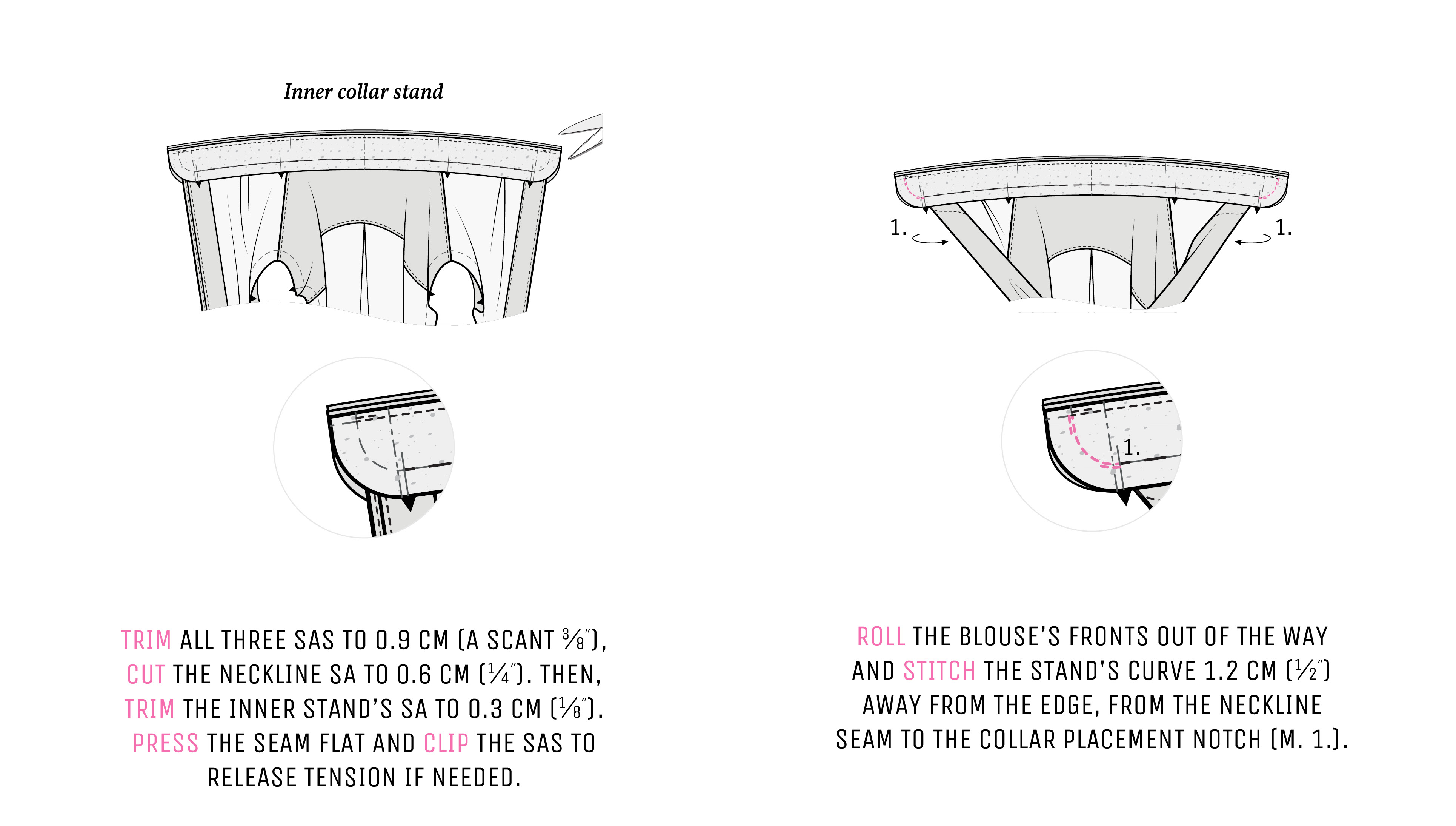
Trim all three seam allowances to 0.9 cm (a scant 3⁄8″). Then, cut the neckline seam allowance to 0.6 cm (1⁄4″); after that, trim the inner stand’s allowance to 0.3 cm (1⁄8″). Press the seam flat. Clip and notch the seam allowances to release the tension, if needed. Be careful not to cut through the stitching.
Roll the blouse’s fronts out of the way and pin the curved edges at the front of the stand. Stitch the curve 1.2 cm (½″) away from the edge, moving from the neckline seam to the collar placement notch (m. 1.) and make neat backstitches.
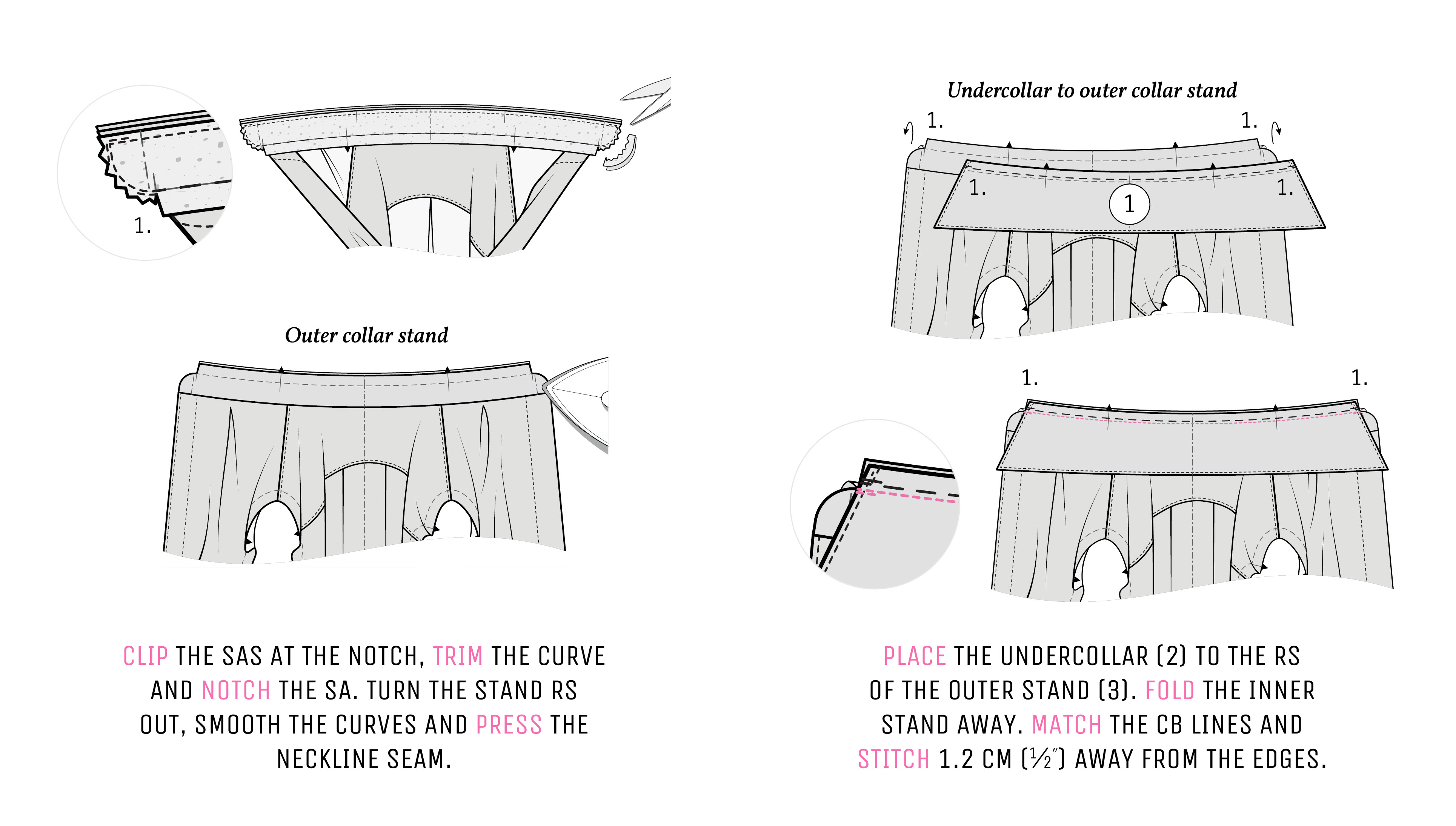
Clip the seam allowances at the notch, trim the curve and notch the seam allowance to avoid bulk later. Turn the stand right side out, smooth the curves and press the neckline seam. Place the undercollar (2) to the right side of the outer stand (3), keeping the inner stand away, and match the notches.
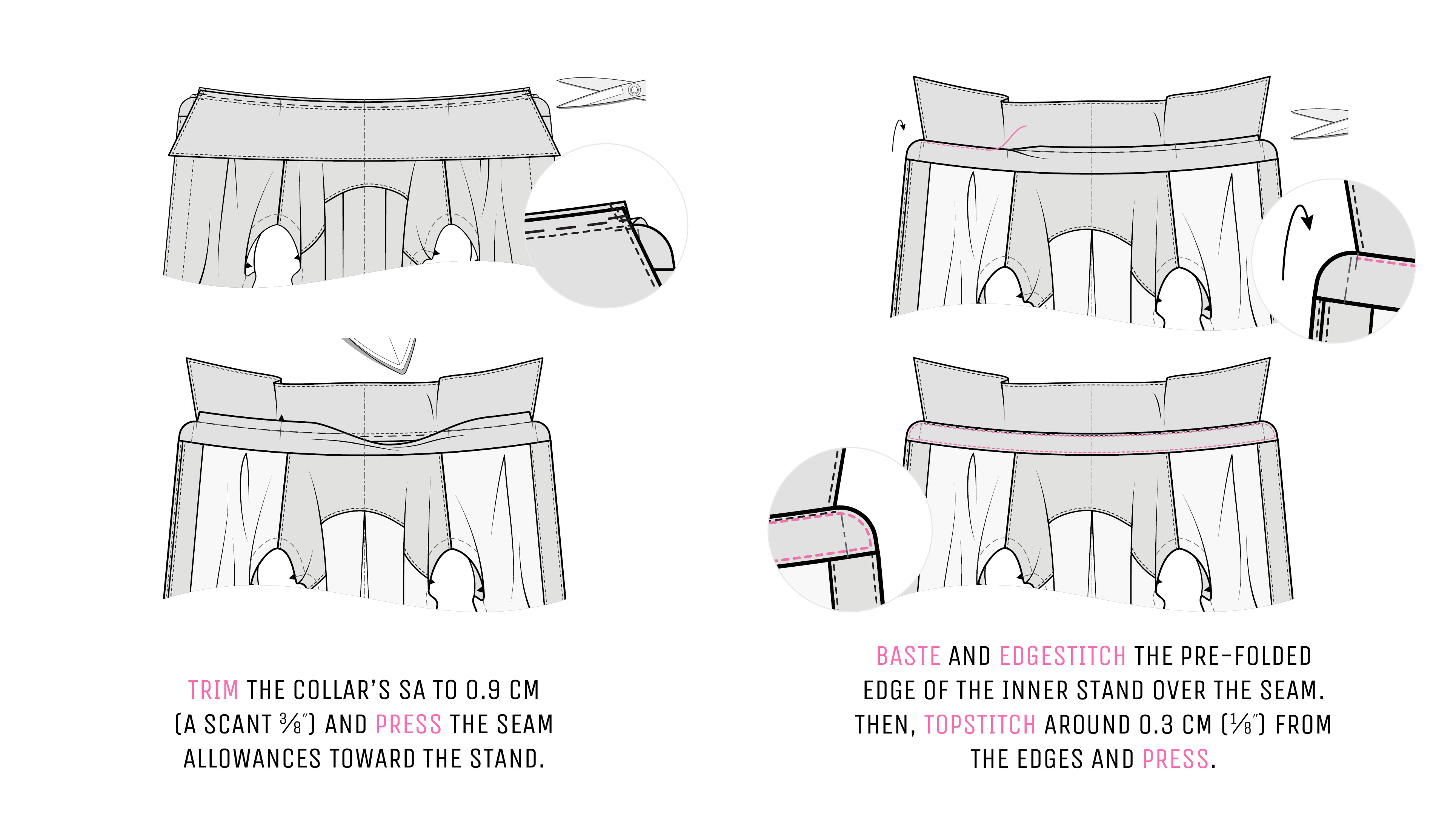
Match the CB lines, pin and stitch 1.2 cm (½″) away from the edges, starting and stopping at the stand’s notches (m. 1.). Trim the collar’s seam allowance to 0.9 cm (a scant 3⁄8″) and press the seam allowances toward the stand.
3. Finish the Stand & Complete the Collar
Trim the pre-pressed seam allowance of the inner stand to 0.6 cm (1⁄4″) and fold it to the wrong side. Then, cover the stitching between the collar and the outer stand with this edge. Make sure the pieces lay smoothly and baste the edge in place. Edgestitch the folded edge of the inner stand over the seam and give the piece a good press. Topstitch around through all layers 0.3 cm (1⁄8″) from the edges and press.
Voilà!
Enjoy your shirt and that crisp new collar you made.
And if you’re continuing with your shirt, the next step might be the buttons. I happen to have an illustrated tutorial on placing buttons and buttonholes that walks through spacing them cleanly along the front. Hope it helps.
xoxo
Yours,
Kaia